
Film School: The 1970s
Submitted Mon, Nov 16, 2009 9:41 by marina
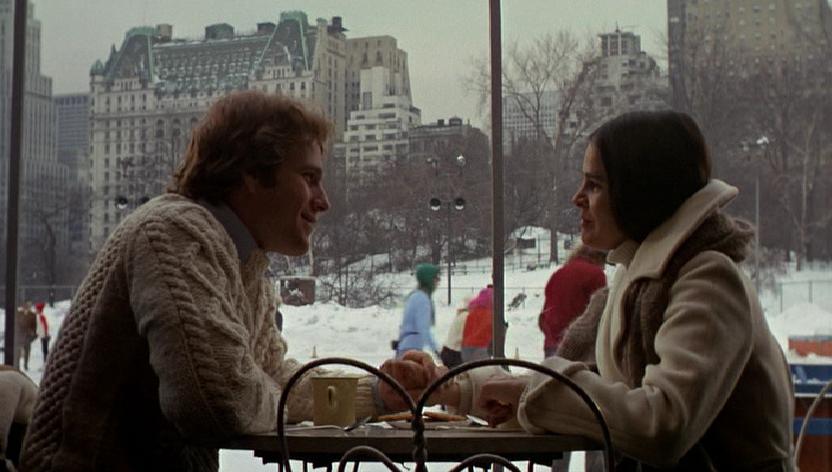
Arthur Hiller's LOVE STORY (1970), the original "chick flick".
The 1970’s began with LOVE STORY (1970), a sentimental “chick flick” that branded the famous line, “Love means never having to say you're sorry." Yet Oliver and Jenny’s gushy romance harks back to the sappier trends of the decades before; as the 70's progressed, America saw more and more popular films begin to portray such topics as love and marriage with bittersweetness, or even cynicism. The love that Oliver and Jenny shared, although full of obstacles, would not even end in death, but in films like ANNIE HALL (1977), a relationship could end simply because love faded, or became less important, or had perhaps never existed in the first place. The film, directed by Woody Allen, chronicles the best and worst moments in a relationship between a neurotic comedian, Alvy Singer (Allen) and the whimsical Annie (Diane Keaton). Allen describes ANNIE HALL as a major turning point in his career: "I said to myself, 'I think I will try and make some deeper film and not be as funny in the same way. And maybe there will be other values that will emerge, that will be interesting or nourishing for the audience.'" By applying his typical irreverent and fatalistic humor to the story of a heartfelt relationship, Allen created a decidedly contemporary romance comedy in the sense that love does not conquer all, but instead exists as something both complicated and painful.

Woody Allen as Alvy Singer and Diane Keaton as Annie in ANNIE HALL (1977).
Among the most popular and widely recognized of such films about complicated relationships is Robert Benton’s KRAMER VS. KRAMER (1979). The film tells the story of a divorce and its impact on a young couple’s battle for custody over young son Billy. Dustin Hoffman stars as Ted Kramer, a workaholic-advertising executive, while Meryl Streep plays his wife, Joanna, who decides to leave her husband and child at the start of the film. The custody battle that ensues in this Academy Award-winning movie marks a significant cultural shift in 1970’s gender role ideology. As such, the film nearly reverses the behaviors that traditionally defined fatherhood and motherhood: Ted, the successful and selfish businessman, tries to become a loving and protective single parent, while Joan, the housewife, embarks on a path toward self-discovery, devoid of any obligations to please her child and husband. Of the film, Roger Ebert wrote in 1979, “KRAMER wouldn't be half as good as it is -- half as intriguing and absorbing -- if the movie had taken sides.” The film successfully portrays the plight of both a male and a female who struggle to define themselves within the structure of a nuclear family.


KRAMER VS. KRAMER, starring Streep and Hoffman, was released in 1979.
The moral ambiguity of 1976’s TAXI DRIVER, a film directed by Martin Scorsese and written by Paul Schrader, also reflects the confused and contradictory social climate of the 70s. Robert De Niro stars as a lonely 26-year old Vietnam veteran named Travis Bickle. In order to cope with his increasing insomnia, Bickle takes a job driving a cab at all hours of the day. He spends much of his time discussing his general loathing for the city and interacts with many different types of New Yorkers, including a racist husband spying on his cheating wife, and a 13-year old prostitute named Iris, played by Jodi Foster. Bickle grows disgusted by New York street crime and becomes intent on rescuing Iris from her dangerous and sad lifestyle. On one hand, Bickle is much like a hero from a Western film transplanted into the harsh reality of a postmodern, urban environment. On the other hand, his violent behavior and aggression resemble a villain from the popular horror films that also emerged in the 70s. In TAXI DRIVER, Scorsese does not instruct his viewers to feel any affinity toward the protagonist nor any disgust with him – he is neither a hero nor a villain, and is neither sane nor crazy. The character’s feelings of displacement reflects the inconsistencies within American culture in the 70s, when the country seemed to lack true leadership or moral direction.

Robert De Niro as Travis Bickle in 1976's TAXI DRIVER.
Michelangelo Antonioni’s THE PASSENGER, released in 1975, also centers on an isolated character who lacks a true and consistent identity. In the film, a TV journalist (played by Jack Nicholson) steals a dead man’s name and embarks on a new life. The film does not contain much of a plotline, as the characters are wanderers who seem to be searching for something, but we don’t know what. “In essence, THE PASSENGER is about a man on the run from himself,” writes Manohla Dargis of THE NEW YORK TIMES. “[It is] a further exploration of a feeling, a mood, that Mr. Antonioni had…described with elegant simplicity: ‘man is uneasy, something is bothering him.’”

THE PASSENGER (1975)
In the aftermath of the Vietnam and the Watergate scandal, America's pervasive sense of doom and distrust in authority remains evident in films like APOCALYPSE NOW (1979), an epic film set in the midst of the Vietnam war. The script is based on Joseph Conrad's novella, Heart of Darkness, and follows the story of two US Army special operations officers, one of whom must assassinate the other. Martin Sheen plays Captain Benjamin L. Willard, a disturbed, alcoholic veteran on the brink of insanity, living in Saigon in 1970 from deployment in the field. Similarly, the 1976 thriller BLACK SUNDAY features a character, Michael Lander (Bruce Dern), whose horrible experiences in the Vietnam War render him deranged and mentally unstable. As Lander plots out his suicide, he decides to kill as many people in the process, and collaborates with a Palestinian terrorist group to launch a suicide bombing at the Olympics on American soil.
Highly regarded as one of the best films of all time, THE GODFATHER, directed by Francis Ford Coppola, was released in 1972. Marlon Brando won an Oscar for his role as the patriarch of the Corleones, a Sicilian family who struggle to stay in power in a corrupt post-war America. Not since the film's release in 1972 has any "gangster" movie escaped a comparison. While THE GODFATHER interprets the Mafia as a product of a corrupt society, older films featuring gangsters had failed to place them in this important context. Only two years later, THE GODFATHER PART II was released in 1974, and remains just as beloved as its prequel, if not more. The film features two interwoven narratives: one follows Robert De Niro as the young Don Vito in Sicily, while the other chronicles the upward mobility of Al Pacino as Michael, who replaces Don.

Marlon Brando won an Oscar for his role in THE GODFATHER.


Comments
Post new comment